


One Outreach Strategy Does Not Fit Every Credit
Institutional credit markets are specialized.
A lender with appetite for commodity inventory may have no mandate for ground-up real estate development. A project finance lender may underwrite contracted renewable-energy cash flows but decline ordinary corporate working capital. A CRE debt fund may understand transitional property risk but have no infrastructure lending capability.
This specialization affects both lender selection and transaction presentation.
A financing request needs to reach institutions that understand the relevant asset, collateral, cash-flow profile and legal structure. It also needs to reach the correct professionals inside those institutions.
That is why a structured lender outreach mandate begins with the transaction itself.
Transaction and Asset-Based Credit
Borrowing bases, inventory finance, receivables finance, pre-export finance, supply-chain structures, letters of credit and other facilities supported by identifiable trade flows.
Long-Duration Project Credit
Energy, renewable power, battery storage, infrastructure and other projects underwritten against project contracts, sponsor support and forecast cash flows.
Property-Level Debt
Acquisition, development, bridge, refinancing and transitional facilities secured against commercial real estate assets and their associated cash flows.
Structured Lender Outreach for Trade Finance
Trade finance lenders generally underwrite the underlying commercial transaction as closely as they underwrite the borrower.
The credit analysis may include the commodity or goods being financed, supplier and buyer quality, payment terms, title transfer, logistics, inventory controls, receivables, insurance, jurisdiction, transaction cycle and cash-conversion mechanics.
A request for a revolving commodity borrowing base therefore needs to be distributed differently from an ordinary corporate term loan.
Depending on the transaction, the lender universe may include commercial-bank trade desks, commodity finance banks, asset-based lenders, receivables financiers, inventory finance providers, private credit funds and specialist trade finance institutions.
Lender selection becomes even more important where the proposed facility involves emerging-market counterparties, cross-border collateral, structured payment instruments or highly specialized goods.
Structured Lender Outreach for Project Finance
Project finance requires a different underwriting framework.
Lenders need to understand how the project reaches completion, how revenue will be generated, which parties carry construction and operating risk, and whether project cash flow can support the proposed debt.
The lender file may therefore include development status, permits, site control, EPC arrangements, equipment supply, offtake contracts, operating assumptions, sponsor equity, financial models, debt-service coverage and technical diligence.
A project that has reached notice to proceed presents a different risk profile from an early-stage development. A contracted utility-scale solar project also belongs in a different credit universe from a merchant power asset.
Effective distribution requires those distinctions to be reflected in the lender mapping.
Structured Lender Outreach for Commercial Real Estate
Commercial real estate lenders focus heavily on the property, sponsor, business plan and expected exit from the facility.
Depending on the transaction, underwriting may include current and stabilized net operating income, debt yield, loan-to-value, debt-service coverage, occupancy, tenant concentration, lease maturity, development costs, capex, sponsor equity and projected asset value.
The correct lender universe changes materially between stabilized investment property, value-add acquisitions, bridge facilities and development transactions.
Banks, debt funds, private credit investors, mortgage lenders and specialty real estate finance institutions can all participate in CRE financing, but their underwriting parameters and return requirements differ considerably.
Structured lender outreach helps determine where the transaction fits before management spends months approaching institutions individually.
What Determines the Lender Universe
The lender list is constructed around the credit characteristics of the individual mandate rather than around a fixed directory of institutions.
Minimum and maximum lender ticket sizes can immediately determine whether an institution belongs in the process.
Borrower jurisdiction, asset location, trade corridors and country exposure affect lender eligibility.
Inventory, receivables, real estate, project assets, contracts and guarantees each require different underwriting expertise.
Lenders need an identifiable source of debt service and ultimate repayment appropriate to the proposed facility.
Distribution Starts After the Credit Is Defined
The quality of lender outreach depends heavily on the quality of the financing request.
Institutional lenders should not have to determine what the borrower is actually asking for.
Before distribution, Financely reviews the requested facility and organizes the core information required for lender screening. This typically includes the borrower or project company, requested amount, currency, use of proceeds, tenor, repayment source, available security and relevant transaction documentation.
For trade finance, that may involve contracts, purchase orders, invoices, inventory reports and transaction-flow information.
For project finance, the file may include the financial model, development status, project contracts, permits and sponsor information.
For CRE, lenders may require the rent roll, operating statement, valuation, sources and uses, property information and sponsor track record.
The purpose is not to produce unnecessary documentation. It is to ensure the lender can make an informed initial screening decision.
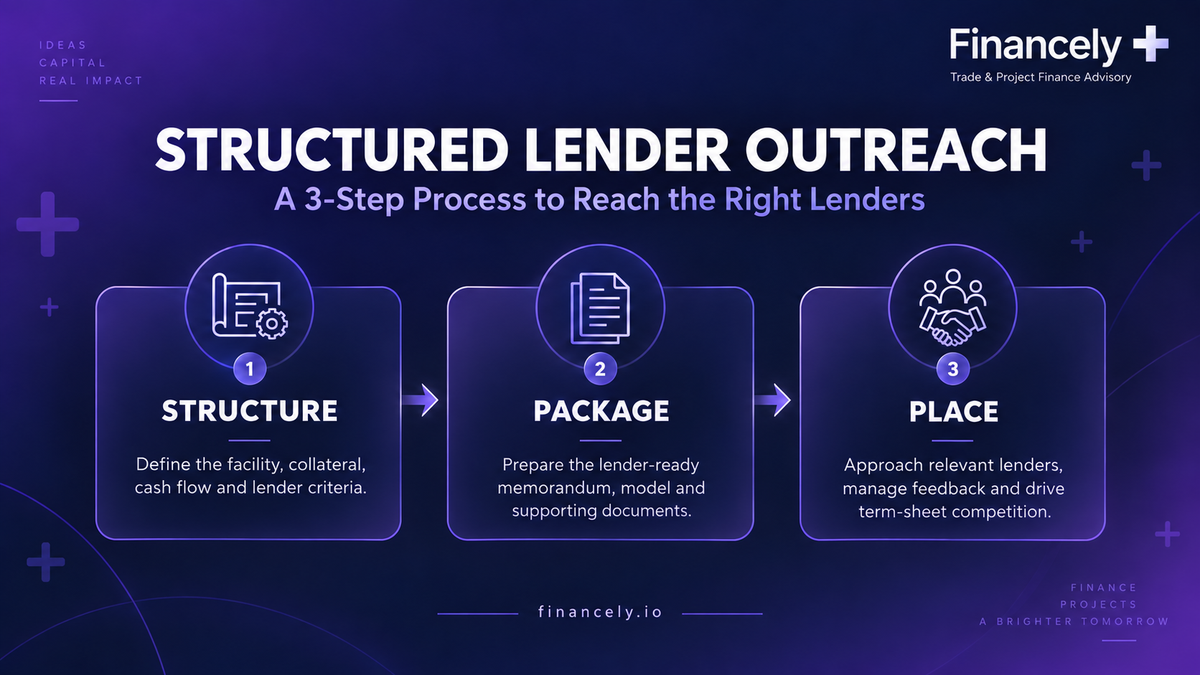
Define the financing request and organize the information needed for institutional review.
Build a lender universe based on transaction type, size, geography, collateral and credit profile.
Approach relevant lenders and manage initial screening, questions and information requests.
Support lender engagement through proposals, diligence, negotiation and transaction execution.
Direct Outreach Is Only the Beginning
A financing process does not end when a lender responds.
Initial interest frequently creates additional questions. A lender may request updated financial statements, details of collateral, additional project information, revised projections or clarification of legal and commercial arrangements.
These requests need to be coordinated while the transaction remains active inside the lender's organization.
Financely manages direct lender follow-up and supports the flow of information between the client and interested counterparties.
The objective is to move serious lenders from preliminary review toward a clear commercial position.
Comparing Lender Proposals
Where several institutions are prepared to engage, management needs to assess more than the interest rate.
Trade finance lenders may differ on advance rates, eligibility criteria, collateral controls and transaction limits. Project finance lenders may differ on leverage, debt-service coverage, reserve accounts and completion support. CRE lenders may offer different loan-to-value levels, amortization schedules, recourse requirements and release provisions.
Those differences can materially affect both the economics of the financing and the borrower's ability to operate under the facility.
| Commercial Term | Areas to Compare |
|---|---|
| Pricing | Interest margin, benchmark rate, upfront fees, commitment fees and other lender charges. |
| Leverage | Advance rate, loan-to-value, debt quantum, debt-service capacity and sponsor equity. |
| Tenor | Maturity, amortization, extensions, repayment profile and refinancing requirements. |
| Security | Collateral package, guarantees, share pledges, account control and lender protections. |
| Covenants | Financial tests, reporting, cash controls, distributions and operational restrictions. |
| Execution | Due diligence, conditions precedent, credit approval, documentation and expected closing process. |
Why Institutional Lender Outreach Requires Active Management
Financing opportunities compete for attention inside every bank, credit fund and specialty lender.
An initial response is useful only if the process continues.
Borrowers therefore need to respond to diligence requests, clarify assumptions, provide supporting documentation and evaluate proposed structural changes without allowing the transaction to stall.
This is particularly important in complex mandates where lenders may need input from multiple internal teams before deciding whether to proceed.
Financely's Structured Lender Outreach mandate is designed around that execution work rather than around the simple delivery of lender contacts.
We Guarantee the Outreach Work
Financely's Structured Lender Outreach mandate includes a 90-day refund guarantee. If Financely has not completed the agreed initial lender distribution within 90 calendar days after the mandate becomes active, the client may request a refund of the Structured Lender Outreach mandate fee.
The guarantee applies to Financely's execution of the agreed lender outreach. It does not depend on a lender approving the transaction, issuing a term sheet or closing a facility.
The 90-day period begins once the mandate fee has cleared and Financely has received the information and documentation reasonably required to distribute the transaction. Periods of delay caused by incomplete client information, delayed responses, changes to the financing request, legal or compliance issues, third-party dependencies or client-requested suspension do not count toward the 90-day period. The applicable engagement letter governs the final refund terms.Which Transactions Are Ready for Lender Outreach?
A transaction does not need to have completed full lender diligence before entering the market, but it needs to be sufficiently developed to support a credible credit discussion.
Financely generally expects an identifiable borrower or project company, a defined financing amount, clear use of proceeds, a supportable repayment source and enough financial or transaction information for lender screening.
A request without financial information, ownership disclosure, transaction documentation or a defined repayment mechanism is unlikely to benefit from immediate distribution.
In those circumstances, the financing request should first be developed into a structure that lenders can evaluate.
Structured Lender Outreach Is an Execution Mandate
Financely does not sell generic lender lists.
The mandate combines transaction positioning, lender mapping, direct distribution, follow-up, management of lender information requests, proposal comparison and execution support.
For a trade finance mandate, that may mean approaching banks and specialist financiers capable of underwriting the underlying trade flows and collateral.
For a project finance mandate, it may mean identifying infrastructure banks, debt funds and project lenders with the correct sector, geography and development-stage appetite.
For a CRE transaction, it may involve banks, bridge lenders, mortgage lenders, debt funds and private credit investors that operate within the appropriate property sector and leverage range.
Structured Lender Outreach Mandate
The engagement is designed for borrowers and sponsors with a defined transaction that are ready to approach institutional lenders.
- Transaction and financing-request review
- Lender-facing positioning
- Lender mapping and prioritization
- Direct institutional lender outreach
- Follow-up and lender communication
- Coordination of lender information requests
- Indicative-term and term-sheet management
- Commercial negotiation support
- Execution coordination
Take the Transaction to the Correct Credit Market
Companies and sponsors often spend months speaking with lenders before discovering that the institutions they approached were structurally incapable of financing the transaction.
That is avoidable.
A trade finance facility should be taken to lenders that understand the underlying commercial cycle. A project finance requirement should be distributed according to project stage, sector, contracts and cash-flow profile. A CRE transaction should be positioned according to the asset, sponsor, leverage and business plan.
The lender universe follows the credit.
Financely manages the process from lender mapping through direct outreach and active execution, with a defined US$10,000 mandate fee and a 90-day refund guarantee covering completion of the agreed initial lender distribution.
Start Structured Lender Outreach
Submit the transaction, borrower or sponsor, financing amount, use of proceeds, repayment source and available security. Suitable mandates can proceed into lender mapping and institutional distribution.
Review Structured Lender OutreachStructured Lender Outreach FAQ
What is structured lender outreach?
Structured lender outreach is a managed distribution process in which a defined credit requirement is positioned, matched with relevant lenders, distributed to selected institutions and actively managed through lender screening, information requests and commercial discussions.
Can Financely handle trade finance lender outreach?
Yes. Trade finance mandates can include borrowing bases, inventory finance, receivables finance, pre-export finance, transactional working capital and other facilities supported by identifiable trade flows and collateral.
Can Financely approach project finance lenders?
Yes. Project finance lender mapping can cover energy, renewable power, battery storage, infrastructure and other projects where the transaction has progressed sufficiently for institutional lender review.
Do you handle commercial real estate lender outreach?
Yes. CRE mandates can include acquisition, refinancing, bridge, development and other commercial property facilities, subject to the transaction's stage, sponsor profile and lender requirements.
How much does Structured Lender Outreach cost?
The Structured Lender Outreach mandate fee is US$10,000, payable upfront when the engagement begins.
What is the 90-day refund guarantee?
If Financely has not completed the agreed initial lender distribution within 90 calendar days after the mandate becomes active, the client may request a refund of the Structured Lender Outreach mandate fee. The mandate becomes active once payment has cleared and the information reasonably required for lender distribution has been received. Client-caused delays, changes to the transaction, compliance issues and other exclusions stated in the engagement letter may pause the 90-day period.
Does the 90-day guarantee mean financing is guaranteed?
No. The guarantee relates to Financely's execution of the agreed lender outreach process. Banks, private credit funds and other lenders remain solely responsible for their own underwriting, pricing, credit approvals and financing decisions.
Is this simply a lender database?
No. The service includes transaction review, lender mapping, direct outreach, follow-up, lender information management, proposal comparison and execution support. The lender universe is constructed around the individual transaction.
Does Financely guarantee a lender term sheet?
No. Lender appetite and credit approval cannot be guaranteed. Financely guarantees only the performance obligations expressly covered by the engagement terms and the 90-day lender-distribution refund guarantee.