
Structured Debt Placement Agent
Structured debt placement for acquisitions, project finance, private credit, trade finance and asset-backed transactions. Lender mapping through closing.
Structured Debt Placement for Complex Financing Mandates
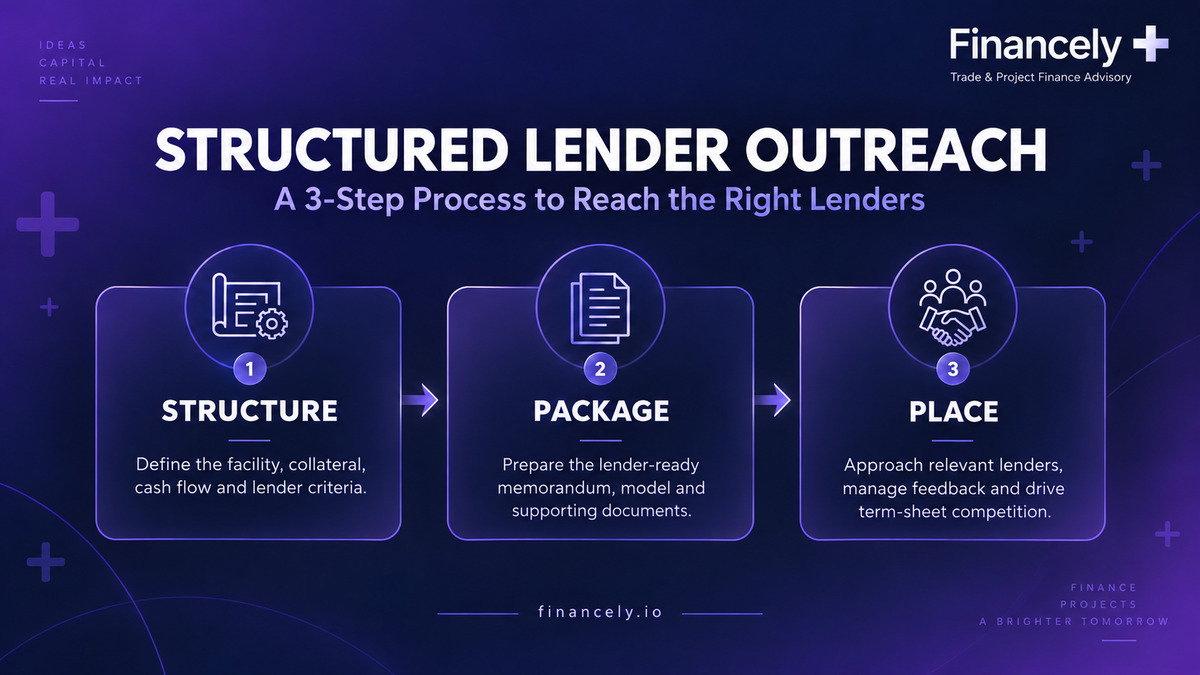
Financely acts as a structured debt placement adviser for companies, sponsors, acquirers, developers and trading businesses seeking institutional debt capital. We structure the financing case, identify the relevant lender universe, position the credit, coordinate lender outreach and manage the placement process through term-sheet comparison and closing.
The mandate is designed for transactions where lender selection, credit architecture, collateral structure, documentation and negotiation materially affect execution. The objective is to create an underwritable financing proposition and place it with capital providers whose mandate matches the transaction.
Run a Controlled Lender Placement Process
Submit the financing requirement, repayment source, transaction structure and supporting documentation. We will assess the mandate and determine the appropriate placement strategy.
Submit Your TransactionWhat a Structured Debt Placement Agent Does
Structures the Credit
We assess debt capacity, repayment mechanics, collateral, tenor, amortization, leverage and structural seniority before distribution.
Maps the Lender Universe
We identify banks, private credit funds, specialty finance firms, asset-based lenders, trade finance providers and other credit investors whose mandate fits the transaction.
Positions the Transaction
We prepare the financing case around the lender's underwriting questions rather than distributing a generic corporate presentation.
Manages Price Discovery
We compare lender feedback, indicative terms and formal proposals across pricing, leverage, collateral, covenants, amortization and execution requirements.
Transactions We Place
Structured debt placement is appropriate where a financing requirement needs targeted lender selection and transaction-specific underwriting.
- Corporate senior and secured debt
- Private credit facilities
- Acquisition finance
- Project and infrastructure finance
- Renewable energy project debt
- Structured commodity and trade finance
- Pre-export and prepayment facilities
- Receivables and borrowing-base facilities
- Inventory and warehouse-receipt finance
- Commercial real estate debt
- Bridge capital
- Equipment and asset-backed facilities
The Placement Process
Underwriting Review
We review the borrower, financing requirement, financial profile, use of proceeds, repayment source, security package and transaction documentation.
Credit Structuring
We determine the appropriate facility type, debt quantum, tenor, amortization, collateral structure and lender positioning.
Placement Preparation
We organize the lender-facing materials. Depending on the mandate, this may include an information memorandum, financial model, debt schedule, sources and uses, collateral analysis and transaction summary.
Targeted Distribution
The transaction is distributed to selected capital providers based on ticket size, jurisdiction, sector, collateral profile, facility type and underwriting appetite.
Lender Engagement
We coordinate lender questions, additional diligence, management interaction and credit feedback throughout the outreach process.
Term-Sheet Comparison
Competing proposals are compared across coupon, fees, leverage, amortization, security, covenants, conditions precedent and execution certainty.
Negotiation and Closing
We support commercial negotiation and coordinate the financing process through lender selection, documentation and closing.
Placement Starts With Debt Capacity
The requested financing amount is not automatically the financeable amount. Debt capacity must be derived from the underlying credit.
Corporate debt may be constrained by leverage, free cash flow, fixed-charge coverage and liquidity. Project finance may be sized against CFADS, DSCR and LLCR. Asset-backed structures depend on collateral eligibility, advance rates, concentration and liquidation value.
Where senior debt capacity falls below the total capital requirement, the capital structure may require sponsor equity, subordinated debt, seller financing, preferred capital or another complementary source.
Lender Mapping Is Transaction-Specific
A lender with available capital may still be irrelevant to a particular mandate. Institutional lenders operate within defined credit parameters.
- Minimum and maximum ticket size
- Jurisdictional mandate
- Sector exposure
- Leverage tolerance
- Collateral requirements
- Minimum sponsor equity
- Required debt-service coverage
- Asset eligibility
- Tenor limitations
- Portfolio concentration limits
Effective placement therefore requires lender selection at the mandate level rather than indiscriminate distribution.
Credit Positioning Before Distribution
The lender-facing case should explain the transaction in underwriting terms. Promotional company information has limited value unless it connects directly to repayment capacity and creditor protection.
Repayment Source
Define the cash flow, receivable, contracted revenue, asset monetization or other source expected to service the debt.
Debt Service
Quantify the borrower's ability to service interest and principal under base-case and stressed assumptions.
Collateral
Identify available security, lien priority, collateral value, advance rates and potential recovery characteristics.
Downside Protection
Establish covenant headroom, reserves, cash controls, guarantees and other structural protections relevant to the lender.
Term-Sheet Comparison Goes Beyond Coupon
Headline interest rates provide an incomplete comparison between financing proposals.
- Interest margin and benchmark
- Arrangement and commitment fees
- Original issue discount
- Mandatory amortization
- Cash sweeps
- Prepayment provisions
- Reserve requirements
- Financial covenants
- Collateral requirements
- Reporting obligations
- Conditions precedent
- Closing certainty
The preferred financing proposal should be assessed on total liability economics and structural flexibility rather than coupon alone.
Indicative Placement Timeline
A routine structured debt placement can often be progressed within approximately 45 days where the transaction is lender-ready and the documentation is complete.
Execution may take longer where the mandate requires financial modelling, restructuring, collateral perfection, valuation, third-party diligence, legal work, permits, credit enhancement or additional sponsor capitalization.
Timing also depends on lender underwriting, credit committee schedules, documentation and satisfaction of conditions precedent.
What We Need to Start
- Legal borrower or issuer entity
- Requested financing amount and currency
- Use of proceeds
- Preferred facility type where known
- Primary repayment source
- Historical financial information
- Financial projections or project model
- Existing debt and security interests
- Available collateral
- Transaction contracts or supporting documentation
- Target closing date
- Previous lender feedback where applicable
Placement Agent vs Direct Lender
Financely structures and manages debt-placement mandates. We are not the lender and capital remains subject to the independent underwriting and approval of third-party banks, credit funds and other capital providers.
Financely does not guarantee financing, credit approval or closing. Our role is to prepare the transaction, identify suitable capital providers, manage outreach, support negotiations and coordinate execution.
Financely is not a broker-dealer and does not underwrite securities. Mandates are structured according to the nature of the transaction and applicable regulatory requirements.
Who This Service Is For
Structured debt placement is intended for principals with a defined financing requirement and sufficient transaction substance to support institutional underwriting.
- Operating companies raising growth or working capital
- Sponsors financing acquisitions
- Developers raising project debt
- Commodity traders financing physical trade flows
- Asset owners refinancing existing liabilities
- Borrowers seeking private credit
- Companies requiring structured or collateralized facilities
Submit Your Financing Mandate
Send us the transaction structure, financing requirement, repayment source and supporting documentation. We will assess the mandate and determine the appropriate lender-placement strategy.
Submit Your Transaction